
FHA Short Sale in Maricopa: How HUD's Pre-Foreclosure Sale Program Works
HUD's structured PFS program runs 6 to 9 months. Here is what to expect at each phase and why it differs from a conventional short sale.
1,300+ career closings · 267 Zillow reviews averaging 5.0 (October 2026) · Licensed in Arizona since 2002
James Sanson | Real Broker | Licensed in Arizona
An FHA short sale uses HUD's Pre-Foreclosure Sale (PFS) program. The borrower applies for acceptance into the PFS program before listing, the home is then marketed at a HUD-defined minimum percentage of appraised value during a defined marketing period (typically 4 to 6 months), and the lender plus HUD review and authorize the sale. Once it closes, the approval states whether the borrower is released from further obligation. Most FHA borrowers can requalify for a new FHA loan after approximately 3 years, subject to current HUD guidelines and lender overlays. Call 520-838-8037 to discuss your specific situation, or contact a HUD-approved housing counselor at hud.gov.
If your Maricopa home is financed with an FHA loan and you are facing financial hardship, the FHA Pre-Foreclosure Sale (PFS) program is the structured framework HUD offers for short sales of FHA-insured mortgages. The program has specific rules, defined timelines, and standardized documentation that differ from conventional short sales. Knowing how the program works helps you set realistic expectations and submit the right paperwork.
This page walks through the FHA PFS program in plain language. The James Sanson Team has handled many FHA short sales for Maricopa homeowners since 2004. The official program is documented in HUD's Single Family Housing Policy Handbook (4000.1), available at the HUD Single Family Housing portal. For your specific situation, call 520-838-8037 or contact a HUD-approved housing counselor at the HUD counselor directory.
What the Pre-Foreclosure Sale program is
The Pre-Foreclosure Sale program (PFS) is HUD's structured framework for resolving FHA-insured mortgages through a short sale rather than foreclosure. As with other short sales, the home is sold for less than the loan balance, the lender and HUD accept the proceeds, and the approval states whether the borrower is released from further obligation. The structural differences from other short sale types:
- HUD-administered framework. The PFS program is structured by HUD and administered through your servicer. Because HUD sets the rules, the program is more standardized than conventional short sales, which vary significantly by servicer.
- Pre-acceptance into the program is required. Unlike conventional short sales, where you list first and seek lender approval after receiving an offer, the FHA PFS program typically requires the borrower to be accepted into the program before listing.
- A defined marketing period. Once accepted, the borrower has a defined window (commonly 4 to 6 months) to find a buyer.
- Minimum acceptable offer percentages. HUD sets a minimum percentage of appraised value that the offer must meet, which typically declines over the marketing period.
- Standardized deficiency treatment. The approval states whether you are released from further obligation once the sale closes, so read it before you sign.
For Maricopa FHA borrowers, this means the process is more predictable than conventional short sales but also more rigid in its requirements.
Who is eligible
HUD's PFS program has specific eligibility criteria that the borrower must meet. The general framework, subject to current HUD guidelines:
- FHA-insured first mortgage. The loan must be FHA-insured (other loan types fall under different programs).
- Documented financial hardship. Job loss, income reduction, medical issues, divorce, death of co-borrower, military relocation, business decline, or similar documented circumstance.
- Inability to maintain the mortgage payment. The hardship must result in a real inability to continue paying. Borrowers who could afford the payment but simply do not want to are generally not eligible.
- Occupancy as a primary residence. The home must have been the borrower's primary residence. Some exceptions exist for prior occupants who relocated for documented reasons.
- Acceptable property condition. The home must be in a condition that allows it to be marketed and sold.
- Not already in deep foreclosure. Properties that have already passed certain foreclosure milestones may not qualify, depending on current HUD timing rules.
The specific eligibility evaluation is made by your servicer based on HUD's current guidelines, which are updated periodically through HUD mortgagee letters. For your specific situation, talk to your servicer's loss mitigation department or a HUD-approved housing counselor.
How the FHA PFS process works
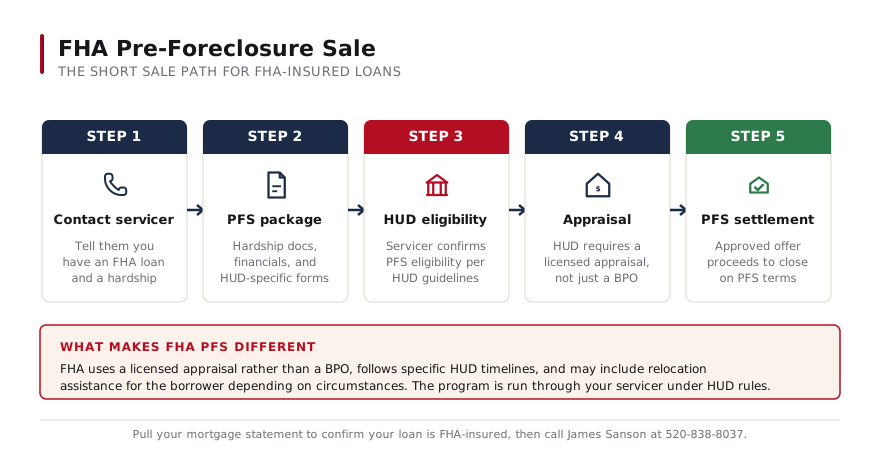
The typical FHA Pre-Foreclosure Sale follows a defined sequence:
- Application for PFS program acceptance. You submit a hardship application to your servicer with financial documentation, occupancy verification, and a brief written description of the hardship. The servicer evaluates whether HUD's PFS eligibility criteria are met.
- Property appraisal ordered. The servicer typically orders an appraisal to establish the current market value. This appraised value becomes the basis for the minimum offer percentage calculations.
- Approval to participate. If eligible, you are accepted into the PFS program for a defined marketing period.
- Listing with an experienced agent. The home is listed at a realistic market price based on the appraised value.
- Marketing period begins. You have a defined window (commonly 4 to 6 months) to find a buyer.
- Buyer's offer received. The offer is evaluated against HUD's minimum acceptable percentage of appraised value for the current month of the marketing period.
- Sales review and approval. The servicer reviews the offer against PFS program requirements and submits it to HUD for authorization when needed.
- Closing. The sale closes per the approval terms, typically 30 to 45 days after approval, with HUD's PFS framework documenting the treatment of deficiencies.
For the underlying mechanics common to all short sale types, see the general short sale process.
The minimum acceptable offer
One of the most distinctive features of the FHA PFS program is its minimum acceptable offer structure. HUD requires that offers meet a minimum percentage of the appraised value, and this percentage typically declines as the marketing period progresses.
In general terms (subject to current HUD guidelines, which may be updated):
- Early in the marketing period (often the first 30 days), offers must meet a higher minimum percentage of appraised value
- In the middle of the marketing period, the minimum percentage typically declines
- Late in the marketing period, the minimum percentage typically declines further
The specific percentages are set by HUD and apply at the time the offer is received, based on how far into the marketing period the home has been listed. The practical implication: if a buyer offer comes in low early in the marketing period, it may not meet HUD's minimum for that timeframe even though the same offer might be acceptable later. Pricing strategy and timing of accepting offers matter.
For your specific PFS program, the current HUD minimum offer percentages should be confirmed by your servicer or an experienced FHA short-sale agent before listing.
Deficiency and release from obligation
One of the practical advantages of the FHA PFS program is how deficiencies are handled. The approval states whether you are released from further obligation once the sale closes, so read it before you sign. Unlike some conventional short sales, where deficiency waiver depends on the specific approval letter and the lender's willingness, the FHA PFS framework has a more standardized approach.
Key points on deficiency under the PFS program:
- HUD compensates the servicer for the loss. The FHA mortgage insurance covers the difference between the sale proceeds and the loan balance, up to the insurance limits.
- The approval states whether the borrower is released from further obligation to the servicer. Once the PFS sale closes and HUD's compensation is processed, the approval states whether the borrower is released from the original mortgage obligation.
- Arizona's anti-deficiency statutes are written for foreclosures. A.R.S. § 33-814 and § 33-729 address trustee sales and judicial foreclosures, so in a short sale the approval letter controls.
The specific deficiency treatment for your PFS will be documented in the approval letter. Before completing the sale, have the approval letter reviewed carefully, ideally with an Arizona-licensed attorney if there are any questions about the terms.
Timing and the marketing period
The marketing period in an FHA PFS is the defined window during which you have to find a buyer. Common timeframes (subject to current HUD guidelines):
- The initial marketing period commonly runs 4 to 6 months from acceptance into the program
- Extensions are sometimes available if the home has been actively marketed, but no acceptable offer has been received
- If no qualifying offer is received, the borrower may be removed from the PFS program, and other resolution paths (deed in lieu, foreclosure) become more likely
The practical implication is that time is structured within the FHA PFS program in a way that conventional short sales do not. The marketing period creates pressure to price competitively and accept reasonable offers quickly, since the clock is ticking.
From listing to closing, the total timeline for an FHA short sale commonly runs 6 to 9 months, including the marketing period, lender review, and the 30 to 45-day closing window. This is generally longer than a VA Compromise Sale or a conventional short sale.
Requalifying for a new FHA loan
One of the more common questions FHA borrowers ask is: When can I qualify for a new FHA loan after a PFS? The general framework:
- Generally, approximately 3 years. FHA generally requires a 3-year waiting period after a Pre-Foreclosure Sale to qualify for a new FHA loan, subject to current HUD guidelines and lender overlays.
- Shorter waits with extenuating circumstances. If your hardship was demonstrably outside your control (death of co-borrower, serious medical issue, documented job loss with subsequent recovery), HUD may allow shorter waiting periods through its extenuating circumstances framework.
- Credit recovery matters. The PFS and the missed payments leading up to it cause damage to credit. Rebuilding credit during the waiting period strengthens future applications.
- The CAIVRS database. Borrowers with previous FHA losses are recorded in HUD's Credit Alert Verification Reporting System (CAIVRS) for a defined period. The CAIVRS entry must be cleared or resolved before a new FHA loan can be approved.
For your specific situation, when you are ready to apply, speak with a licensed Arizona mortgage loan officer who can pull your CAIVRS status, check current FHA seasoning requirements, and walk you through the qualification process.
Common pitfalls FHA borrowers should know
Several recurring issues specifically affect FHA short sales. Watch for these:
- Listing before PFS acceptance. Unlike conventional short sales, FHA PFS typically requires program acceptance before listing. Listing first can complicate or delay the process.
- Pricing too low early in the marketing period. An acceptable offer that comes in early may not meet HUD's higher minimum percentage for the first phase of the marketing period. Strategic pricing matters.
- Missing the CAIVRS clearance issue. Borrowers sometimes assume a successful PFS gives them an immediate path back to FHA. The CAIVRS database entry and the seasoning period must both be cleared.
- Failing to complete the program before the marketing window closes. If no qualifying offer is received in the defined window, the borrower may be removed from PFS and lose program benefits.
- Working with an agent unfamiliar with FHA PFS. The minimum offer percentages, marketing period structure, and HUD documentation requirements are specific. An agent who has not done FHA short sales may not know how to navigate them.
- Not engaging a HUD-approved housing counselor. The free counseling is especially useful for FHA borrowers because counselors are familiar with the PFS program and can help strengthen their applications. See HUD-approved housing counselors.
The James Sanson Team has handled FHA PFS short sales for Maricopa homeowners and is familiar with the specific requirements. Call 520-838-8037 to talk through your situation.
Important.This page describes the FHA Pre-Foreclosure Sale program in general terms for Maricopa homeowners. Specific eligibility, minimum offer percentages, marketing periods, and waiting periods depend on current HUD guidelines, which are updated periodically through HUD mortgagee letters and the Single Family Housing Policy Handbook (4000.1). For your specific situation, consult a HUD-approved housing counselor throughthe HUD-approved counselor list, your servicer's loss mitigation department, or a licensed Arizona mortgage loan officer. For legal questions about deficiency or your specific loan, consult an Arizona-licensed attorney. The James Sanson Team is not affiliated with HUD or any federal agency and does not provide legal or tax advice. No specific outcome can be promised.
If you have an FHA-insured mortgage and are facing financial hardship in Maricopa, call 520-838-8037 to talk through whether the Pre-Foreclosure Sale program fits your situation. We are familiar with the specific requirements and will be honest about whether your circumstances fit. To compare with other loan types, see VA Compromise Sale or conventional short sale. If your loan involves a second mortgage or HELOC, additional complexity applies, as discussed in the second mortgage or HELOC complications. For the broader silo context, see how short sales differ by loan type. Maricopa short sale specialists with over two decades of experience across FHA, VA, conventional, and USDA short sales.
Tell us about your situation
No pressure, no obligation, no charge. James will call you back personally to discuss your options. For faster help, call 520-838-8037.
Frequently asked questions
Is an FHA short sale the same as a regular short sale?
Do I have to apply for the PFS program before I can list my home?
How long can it take to complete an FHA short sale?
What is CAIVRS and why does it matter for FHA borrowers?
What happens if I can't find a buyer in the marketing period?
Does the deficiency get waived in an FHA short sale?
Can The James Sanson Team handle my FHA short sale?
Talk to a Maricopa specialist today
Behind on payments or weighing your options? Call James for a confidential conversation, with no pressure and no obligation.
520-838-8037James Sanson | Real Broker | Licensed in Arizona
Talk to a Maricopa short sale specialist
Call 520-838-8037 now, or fill out the form and we aim to reach out within one business day.