
How Much Will a Maricopa Short Sale Hurt Your Credit Score?
The typical point drop, how long the mark stays on your report, and the 2-to-4-year timeline to qualify for a new mortgage after a short sale.
1,300+ career closings · 267 Zillow reviews averaging 5.0 (October 2026) · Licensed in Arizona since 2002
James Sanson | Real Broker | Licensed in Arizona
A short sale damages your credit, generally less severely than a foreclosure. Much of the damage typically comes from the missed payments leading up to the sale, though the short sale itself can still be a significant derogatory event, especially for borrowers who were not deeply delinquent before the sale. Depending on the loan program, many homeowners can qualify for a new mortgage within two to four years of a completed short sale. The waiting-period advantage is most pronounced with conventional loans; FHA and VA tend to treat short sales, deeds in lieu, and foreclosures much the same. Call 520-838-8037 to talk through whether a short sale fits your situation, or speak with a free HUD-approved housing counselor at hud.gov.
When homeowners ask about a short sale, credit is often the first concern. "How bad will this hurt my credit?" and "How long until I can buy another house?" are the two questions that come up in nearly every conversation. The honest answer is that the credit damage is real but recoverable, the timeline is shorter than most people expect, and the path back depends as much on what you do after the short sale as what happens during it.
This page covers what credit reporting looks like for a short sale, how it compares to a completed foreclosure or deed in lieu, when you can realistically qualify for a new mortgage under each loan program, and what actions speed up or slow down the recovery. We have walked Maricopa homeowners through this since 2004 and helped many of them buy again afterward. Call 520-838-8037 to discuss your specific situation, or speak with a free HUD-approved housing counselor at hud.gov for neutral guidance.
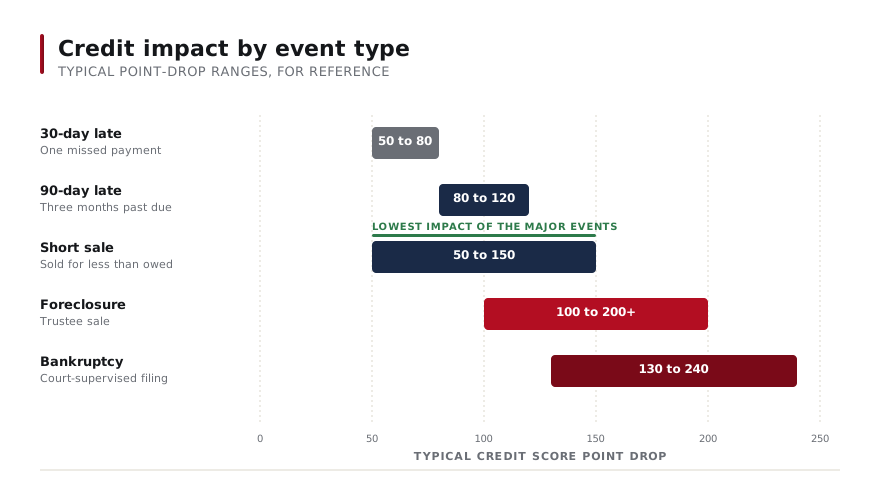
What actually affects your credit during this
The credit damage in a pre-foreclosure situation comes from several distinct events, and understanding which is doing what helps you make better decisions:
- Missed mortgage payments. This is the biggest single source of damage. Each late payment that crosses a 30-day, 60-day, 90-day, or 120-day reporting threshold compounds the impact. A loan in serious delinquency before any sale or foreclosure has already substantially damaged the homeowner's credit.
- The short sale or foreclosure event itself. When the loan resolves (through sale, deed transfer, or foreclosure), a specific notation is reported. This adds to the damage but is typically a smaller increment than the missed payments themselves.
- Other accounts that suffer. Many homeowners in financial hardship also fall behind on credit cards, auto loans, or other accounts. This compounds the damage beyond just the mortgage line.
The practical takeaway is that the short sale notation is one piece of a larger picture. For homeowners whose credit is already significantly damaged by months of missed payments, the marginal impact of the short sale notation itself is often less than people fear. For homeowners who were less delinquent before the short sale (for example, those who pursued the sale early in their hardship), the short sale entry itself can still represent a significant derogatory event. The impact depends on your specific credit profile leading into the sale.
How short sales are reported on credit
Short sales are not reported uniformly. Different lenders use different terminology, and credit bureaus categorize entries based on what lenders report. Common notations seen on a short sale credit entry include:
- "Settled" or "Account paid in full for less than the full balance."
- "Paid in settlement."
- "Short sale" (less common as a specific designation)
- "Account closed"
The specific notation matters less than people sometimes assume. Credit scoring models (FICO and VantageScore in particular) look at the underlying behavior more than the label. A "settled for less than full balance" entry, combined with prior missed payments, produces a relatively predictable impact on the score, regardless of exactly how the lender phrases the closure.
The entry typically remains on your credit report for up to seven years from the original date of delinquency. Note that this is from the original delinquency, not from the date the short sale closed. If you fell behind in March 2025 and the short sale closed in December 2025, the entry generally drops off in early 2032, not late 2032.
Credit impact: short sale vs foreclosure
This is the comparison that matters most to homeowners weighing their options. FICO and VantageScore (the two main credit scoring model providers) do not publish exact point impacts for short sale, deed-in-lieu, or foreclosure events, so outcomes vary by borrower, and any precise number you read online should be treated with skepticism. The general pattern, based on lender guidance and industry observation:
- Short sale: generally less severe than foreclosure. The credit scoring impact is typically meaningful but, in most cases, not as severe as a completed foreclosure. The reporting is "settled" rather than "foreclosed," and recovery typically begins once the account is resolved and no new delinquencies occur.
- Foreclosure is more severe in most cases. A foreclosure entry is generally treated as a more serious derogatory mark by scoring models. Recovery typically takes longer.
- Both: seven-year credit report duration. Both stay on the report for up to seven years from the original delinquency.
The biggest practical difference is often in waiting periods to qualify for a new mortgage, and this gap is largest under conventional loan programs. Under FHA, VA, and USDA programs, the waiting periods for short sale and foreclosure are often similar. For a deeper comparison of the two paths beyond just credit, see the difference between short sale and foreclosure.
Credit impact: short sale vs deed in lieu
Short sale and deed in lieu produce similar credit damage in terms of point impact. The scoring models generally treat them as roughly equivalent negative events. The specific reporting language differs:
- Short sale: "Settled for less than full balance" or similar
- Deed in lieu: "Deed received in lieu of foreclosure" or similar
The bigger practical difference is in waiting periods to qualify for a new mortgage, especially under conventional loan programs, where a short sale typically has a shorter wait than a deed-in-lieu. For the broader comparison, see short sale or deed in lieu.
When you can qualify for a new mortgage
This is the question most homeowners care about most: how long before I can buy again? The answer depends on the loan program you will use for the next mortgage. Each program has its own seasoning requirements, which are subject to lender overlays and policy updates.
| Loan ProgramAfter Short Sale,After Deed-in-Lieu,After Foreclosure | |||
| Conventional (Fannie Mae / Freddie Mac) | Generally, 2 to 4 years, depending on down payment and circumstances | Generally, a 4-year standard | Up to 7 years standard |
| FHA | Generally, 3 years; shorter with documented extenuating circumstances and on-time payments before the short sale | Generally 3 years | Generally 3 years |
| VA | Generally 2 years | Generally 2 years | Generally 2 years |
| USDA | Generally 3 years | Generally 3 years | Generally 3 years |
These guidelines change. Fannie Mae and Freddie Mac update their selling guides periodically, FHA publishes mortgagee letters that adjust requirements, and individual lenders apply their own overlays that may be stricter than the agency baseline. For your specific situation, speak with a licensed mortgage loan officer about current requirements at the time you are ready to apply.
The general pattern across most loan programs is that a short sale often produces the shortest waiting period to qualify again, especially under conventional loan programs. A deed-in-lieu is similar to, or slightly longer than, foreclosure, and foreclosure is typically the longest under conventional programs. Under FHA, VA, and USDA, the differences across event types are small or nonexistent. This is one of the most concrete practical reasons a short sale is often the better path for homeowners who expect to want a mortgage again.
How credit recovery actually works
Credit scores are not punishments. They are predictions of future repayment behavior based on past behavior. A negative event hurts the score because it predicts a higher risk. As time passes and new positive behavior accumulates, the score recovers because the negative event has less predictive weight.
For most homeowners coming out of a short sale, the typical recovery trajectory looks like this:
- The first six to twelve months after the short sale closes are the lowest point. The recent negative still carries heavy weight, and the new positive history has not had time to build up.
- By twelve to twenty-four months, if you have established consistent on-time payments on remaining accounts (credit cards, auto loans, utilities), most homeowners see meaningful score recovery.
- By twenty-four to thirty-six months, many homeowners are in the qualifying range for FHA or conventional mortgages, depending on the program and their specific profile.
- By three to four years, most homeowners who have managed their credit responsibly are in a similar standing to where they would be without the short sale, with the entry still on their report but no longer dragging the score significantly.
This is the typical pattern, not a promise. Your specific recovery depends on your starting credit profile, the depth of damage during the hardship, what other accounts may have suffered, and what positive behavior you build going forward. If you are weighing whether a short sale is worth pursuing given your specific credit picture, call 520-838-8037, and we will talk through it honestly.
What helps rebuild faster
Several specific actions help speed up the recovery after a short sale:
- Pay every other account on time. Credit cards, auto loans, utilities that report to credit bureaus, and any installment loans. Each on-time payment after the short sale builds positive history that offsets the negative.
- Keep credit card balances low. Credit utilization (how much of your available credit you use) is one of the most significant scoring factors. Keeping utilization under 30 percent (and ideally under 10 percent) helps.
- Do not close old accounts. Length of credit history matters. If you have credit cards you have held for years, even if you barely use them, keeping them open helps.
- Do not open many new accounts quickly. Each new credit inquiry has a small negative impact, and a flurry of new accounts over a short period can appear as financial stress.
- Use a secured credit card if needed. If your credit is too damaged for traditional cards, a secured credit card (where you deposit cash as collateral) can help you rebuild your credit with little risk.
- Pull your credit reports. Free at annualcreditreport.com from each major bureau. Verify that the short sale is reported accurately and that no other errors are dragging your score.
- Address any errors. If something is reported incorrectly, dispute it in writing with the credit bureaus. Errors are common after major credit events.
None of these is a quick fix. Credit recovery is a function of time plus positive behavior, and there is no legitimate shortcut. Be cautious of "credit repair" services that promise quick results. The Consumer Financial Protection Bureau has published warnings about these services.
What slows recovery down
Some patterns specifically delay credit recovery after a short sale:
- Additional late payments on other accounts. Each new 30-day or 60-day late payment on any account is another negative event that the recovery has to absorb.
- Charge-offs on credit cards or other accounts. Often happens during the same hardship that led to the short sale. Each one adds to the recovery burden.
- Collection accounts. Unpaid medical bills, utility bills, or other debts going to collections create additional negative entries.
- Bankruptcy was filed after the short sale. A bankruptcy constitutes a separate, very significant credit event that materially extends the recovery timeline.
- New high-balance loans. Opening a high-balance auto loan or other installment debt soon after the short sale can suggest renewed financial stress.
- Maxing out remaining credit cards. High utilization on remaining cards is one of the fastest ways to keep a score depressed.
If you are pursuing a short sale and worried about other accounts that may follow it into trouble, that is exactly the kind of broader financial review a HUD-approved housing counselor can help with. Many counselors review the whole household budget, not just the mortgage.
Important.This page describes the typical credit consequences of a short sale, a deed in lieu, and foreclosure for Maricopa homeowners in general terms. Specific credit outcomes depend on your starting credit profile, what other accounts may suffer during your hardship, current scoring model behavior, and lender overlays at the time you next apply for credit. For questions about your specific credit situation, consider speaking with a HUD-approved housing counselor (many provide free credit review) or a licensed credit professional. For tax questions about forgiven mortgage debt, consult a CPA. No specific score outcome or future qualification result can be promised.
If you are weighing a short sale and want to talk through how it would specifically affect you, call 520-838-8037. We are happy to discuss your situation honestly and refer you elsewhere if a different path would serve you better. To compare against alternatives, see comparing short sale and foreclosure or how a deed in lieu compares. For a closer look at the foreclosure side of the timing, see your foreclosure timeline in Arizona, and for free neutral guidance, see free HUD counseling. If you have decided a short sale is the right path, the next read is the Maricopa short sale process. For the broader context of options, return to facing pre-foreclosure in Maricopa. The James Sanson Team has helped Maricopa homeowners through this for over two decades.
Tell us about your situation
No pressure, no obligation, no charge. James will call you back personally to discuss your options. For faster help, call 520-838-8037.
Frequently asked questions
How many points will my credit score drop after a short sale?
Can I get a mortgage right after a short sale?
Will my employer find out about my short sale through a credit check?
Does a short sale show up on a public records search?
If I had perfect credit before the hardship, can I recover to perfect credit again?
Do I owe taxes on the forgiven mortgage debt after a short sale?
Is there anything I should NOT do to my credit during a short sale?
Talk to a Maricopa specialist today
Behind on payments or weighing your options? Call James for a confidential conversation, with no pressure and no obligation.
520-838-8037James Sanson | Real Broker | Licensed in Arizona
Talk to a Maricopa short sale specialist
Call 520-838-8037 now, or fill out the form and we aim to reach out within one business day.