
Loan Modification or Short Sale: Which Is the Right Move for Your Maricopa Home?
When a modification will actually help, when it just delays the problem, and how to know if a short sale is the better long-term answer.
1,300+ career closings · 267 Zillow reviews averaging 5.0 (October 2026) · Licensed in Arizona since 2002
James Sanson | Real Broker | Licensed in Arizona
A loan modification keeps you in your home by permanently changing your mortgage terms to make the payment affordable. A short sale lets you exit by selling the home for less than you owe with lender approval. The right path depends on three things: whether you want to keep the home, whether you can afford a modified payment, and whether your lender will agree to a modification. Before deciding, talk to a free HUD-approved housing counselor at hud.gov. If a short sale is on the table, call 520-838-8037.
If you are weighing a loan modification against a short sale, you are facing one of the most important decisions a homeowner in financial hardship makes: try to keep the home, or accept that selling is the right path forward. Neither option is universally better. They fit different situations.
This page walks through both honestly, with the practical context of what each really involves. The James Sanson Team has helped Maricopa homeowners through short sales since 2004. We do not negotiate loan modifications, and one of the questions this page answers is why. Before deciding, the best first call is usually to a free HUD-approved housing counselor at hud.gov, who can review both options with you without trying to sell you anything.
Loan modification and short sale are defined
Loan modification
A loan modification is a permanent change to the terms of your existing mortgage agreed to by your lender. The original loan stays in place, but its terms are restructured to make future payments affordable. Common modifications include:
- Reducing the interest rate (sometimes substantially)
- Extending the loan term (commonly to 40 years, sometimes longer)
- Capitalizing past-due amounts into the new principal balance
- Deferring a portion of the principal to a balloon payment at loan maturity
- In rare cases, reducing principal directly
The result is a new monthly payment that fits your current income. You keep the home, you keep the mortgage, you keep making payments under the new terms. This is the "stay" option.
Short sale
A short sale is the sale of your home for less than you owe on the mortgage, with your lender's permission. The lender agrees to accept the sale proceeds as satisfaction of the loan, even though they will not cover the full balance. You list the home, accept an offer, submit it to the lender for approval, and (if approved) close the sale at the negotiated price. Whether you owe anything after closing is set by the lender's written approval letter. Many letters waive the remaining balance; some reserve it or ask for a contribution, so have an Arizona-licensed attorney review the letter before you sign. This is the "exit" option.
The fundamental distinction is direction. Loan modification is about adjusting your relationship with your lender so the loan can continue. A short sale is about ending the relationship cleanly.
Side-by-side comparison
| FactorLoan ModificationShort Sale | ||
| Outcome | Keep the home with new payment terms | Sell the home and exit the mortgage |
| Lender involvement | Loss mitigation department negotiates new terms | Loss mitigation department approves the sale below the balance |
| Income requirement | Must demonstrate the ability to make a modified payment | Must demonstrate hardship; future income matters less |
| Time required | 3 to 9 months from application to permanent modification | 90 to 180 days from listing to closing |
| Credit impact | Missed payments leading up to the modification itself may or may not be reported separately | Missed payments are damaging; the sale was reported as "settled for less than full balance." |
| Future mortgage qualification | Generally favorable if modification is performed on time, though some loan programs treat past modifications carefully | Typically, 2 to 4 years before requalifying |
| Property required to remain | Usually, it must be the primary residence at the time of application | Primary residence preferred; investment properties sometimes eligible |
| Realistic approval rate | Highly variable; depends on income, hardship, and lender policy | Generally higher when an experienced agent and a reasonable offer are involved |
| Who handles negotiation | You + servicer's loss mitigation, often with HUD counselor assistance | Real estate agent experienced in short sales, working with lenders |
| Cost to homeowner | Generally, $0; HUD counselor assistance is free | Set by the approval letter; closing costs usually paid from sale proceeds |
When loan modification is the right path
A loan modification fits when you genuinely want to keep the home AND can realistically afford a modified payment. The clearest cases:
- Temporary or recovered hardship. You lost income for a defined period (medical leave, layoff, divorce transition) but have since stabilized. You can document current income that supports a modified payment.
- Strong equity position. You have meaningful equity in the home. Walking away from it means walking away from real money.
- Family or location reasons to stay. School districts, family proximity, neighborhood ties, special-needs accommodations: reasons that make moving genuinely costly beyond the financial.
- Manageable arrears. Your past-due amount is small enough that the lender can capitalize it into the new balance without making the modified payment unaffordable.
- Long-term income outlook is stable. Even at a reduced payment, you can reasonably expect to maintain payments over the remaining loan term.
If most of these apply to you, loan modification is worth pursuing seriously. The right starting point is your servicer's loss mitigation department, ideally with help from a HUD-approved housing counselor. For a deeper introduction to the counselor relationship, see calling a HUD counselor.
When a short sale is the right path
A short sale is a fit when keeping the home is not realistic, even with modified terms. The clearest cases:
- Income is permanently reduced. Job loss with no clear path back, business closure, disability, or retirement on a fixed income that does not support even a modified payment.
- Underwater with no recovery in sight. You owe substantially more than the home is worth, and home values in your area have not recovered (or are not expected to within a reasonable timeframe).
- Divorce or separation requires a sale. The decision to keep the home is no longer yours alone.
- Relocation required. Job change, family obligations, or other commitments require you to move, and you cannot keep the home as a rental on terms that work.
- Loan modification has been attempted and declined or failed. You have already gone through the process, and the lender either declined or you could not afford the modified terms.
- Multiple liens or complications. Second mortgages, HELOCs, or judgments make it unlikely a modification can resolve the full picture.
If most of these apply, a short sale is often the cleanest path forward. The James Sanson Team handles short sales directly. Call 520-838-8037 to talk through whether your specific situation fits. For the full step-by-step view, see what the short sale process looks like.
What it takes to qualify for each
The qualification requirements for the two paths are genuinely different. They are not just two flavors of the same conversation.
Loan modification qualification
Lenders generally evaluate loan modification applications on three things: documented hardship, current ability to pay a modified payment, and continued occupancy of the home as your primary residence. Specific lender requirements vary, but typical components include:
- Hardship letter describing the cause of the inability to keep current payments
- Recent pay stubs and proof of income for all borrowers
- Bank statements (typically two to three months)
- Tax returns (typically two years)
- Profit and loss statements if self-employed
- A monthly budget showing income, expenses, and what payment you can afford
- Proof of occupancy
- Loss mitigation application form specific to your lender
The hardest part of the loan modification application is often documenting that you have enough income to make the new payment but not enough to make the current one. Lenders look closely at this. If your documented income is too low, they may decline; if too high, they may insist you should be able to pay the existing amount.
Short sale qualification
Short sale qualification is generally more focused on documented hardship and the home's realistic value. Typical requirements:
- Hardship letter explaining why a short sale is necessary
- Financial documentation similar to loan modification (pay stubs, bank statements, tax returns)
- Listing agreement with a real estate agent
- A buyer's offer that the lender considers reasonable, given the property's market value
- Authorization for your agent to communicate with the lender on your behalf
Future income matters less because the goal is to exit, not to continue paying. What matters more is the hardship and the offer's relationship to the current market value. An experienced short sale agent helps shape the listing price and document package to maximize the chance of lender approval.
How each process actually works
Loan modification process
- Initial inquiry. You contact your servicer's loss mitigation department or work with a HUD-approved housing counselor to start the application.
- Application submission. Complete the loss mitigation application package and submit financial documentation.
- Review period. The lender reviews your application, sometimes for weeks or months. They may request additional documents.
- Trial Period Plan. Many modifications begin with a three-month Trial Period Plan, during which you make the proposed modified payment on time each month.
- Permanent modification. If you make all trial payments on time and the lender confirms the modification, new permanent terms are signed and recorded.
Total time from application to permanent modification typically runs three to nine months. Communication delays are common. Persistence matters.
Short sale process
- Initial consultation. Your real estate agent evaluates your situation and confirms that the short sale path makes sense.
- Listing. The home is listed at a realistic market price.
- Buyer offer. A buyer makes an offer; you accept it as the listing seller.
- Short sale package to the lender. Your agent submits the accepted offer along with your hardship documentation to the lender's loss mitigation department.
- Lender review. The lender reviews the offer and your documentation, may order a Broker Price Opinion or appraisal, and either approves, counter-offers, or declines.
- Approval and closing. If approved, the sale closes at the agreed terms within 30 to 45 days.
Total time from listing to closing typically runs 90 to 180 days. Arizona foreclosure timeline and short sale timing often run in parallel, which is why early action matters.
Why James handles short sales, not loan mods
This is a question some homeowners ask, and the answer is worth being direct about.
Loan modification is fundamentally a financial-documentation negotiation between you and your servicer's loss mitigation department. It involves analyzing your budget, projecting your sustainable payment, and packaging that case in a way the lender's underwriters will accept. The people best suited to that work are HUD-approved housing counselors and, for complex situations, attorneys who specialize in foreclosure defense.
Real estate agents do not have the right tools or training for loan modification work. We are licensed to sell homes, not to negotiate the restructuring of mortgage debt unrelated to a sale. Pretending otherwise (which some agents do) creates two problems: the homeowner receives advice from someone outside their lane, and the agent earns nothing unless they sell the home, creating a structural bias toward recommending the sale path.
James does not have that bias because James does not do loan modifications. If your situation is better served by a loan modification, we will tell you and refer you to a HUD counselor or attorney who can help. If it turns out a short sale is the right path, we handle that directly. The clean line between what we do and what we refer to is meant to protect you.
Choosing your path
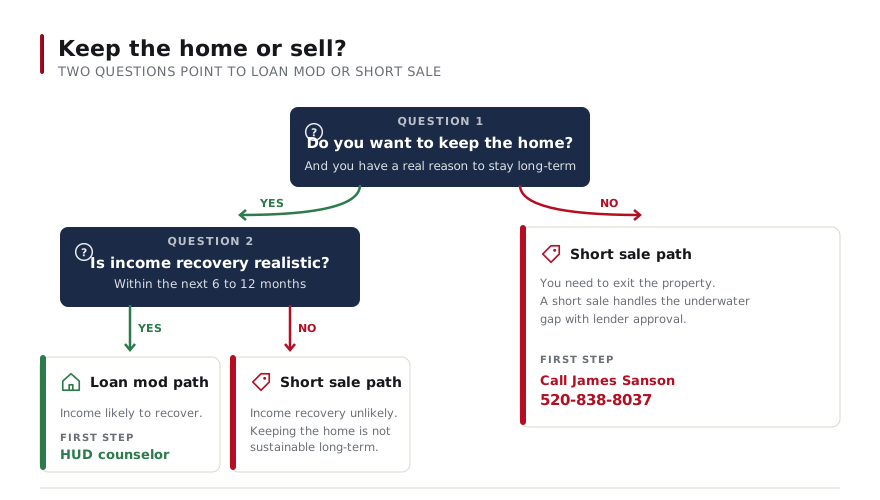
In practice, the choice between loan modification and short sale often comes down to a few honest questions:
- Do you genuinely want to stay in this home long-term? If yes, loan modification is worth pursuing. If no (for whatever reason), a short sale is the more honest path.
- Can you afford a realistically modified payment? If your current income clearly supports the kind of modified payment a lender would offer (typically a 20 to 40 percent reduction from your current payment), modification is viable. If not, the modification is unlikely to succeed in the long term.
- Has your hardship resolved or stabilized? If the cause of your difficulty is behind you and your income is back, modification is the path forward. If the hardship is ongoing or unresolved, a short sale may be more realistic.
- Where are you in the timeline? If you have time on your side (no scheduled trustee sale or sale 60+ days out), both paths are viable. If you are weeks from a trustee sale, the timing realities of each option matter.
If your honest answers point toward modification, start with a HUD-approved housing counselor or your servicer's loss mitigation department. If they point toward short sale, call 520-838-8037 for a free, confidential conversation about whether your situation fits.
Important.This page compares loan modification and short sale outcomes for Maricopa homeowners in general terms. Your specific situation may have legal, tax, or financial dimensions that require professional advice. For legal questions, consult an Arizona-licensed attorney. For free, neutral mortgage assistance counseling, contact a HUD-approved housing counselor at hud.gov. Each outcome described above is subject to lender approval, eligibility requirements, and circumstances that vary by situation. No specific result can be promised.
Most homeowners weighing this choice find clarity after one honest conversation. Call 520-838-8037 if a short sale may be a good fit for your situation. If a modification looks more realistic, start with a HUD counselor at hud.gov. You can also revisit the broader context at pre-foreclosure help in Maricopa, compare paths in comparing short sale and foreclosure, or read about how the credit impact compares. Our Maricopa AZ short sale specialists have walked Maricopa homeowners through this decision since 2004.
Tell us about your situation
No pressure, no obligation, no charge. James will call you back personally to discuss your options. For faster help, call 520-838-8037.
Frequently asked questions
Can I apply for a loan modification and a short sale at the same time?
If my loan modification is approved, will my credit improve right away?
Can my lender deny a loan modification even if I qualify?
Is a short sale faster than a loan modification?
Will I owe taxes on the modified or forgiven debt?
What if I want to keep the home but my lender is not offering a workable modification?
Why would James recommend a loan modification when his team handles short sales?
Talk to a Maricopa specialist today
Behind on payments or weighing your options? Call James for a confidential conversation, with no pressure and no obligation.
520-838-8037James Sanson | Real Broker | Licensed in Arizona
Talk to a Maricopa short sale specialist
Call 520-838-8037 now, or fill out the form and we aim to reach out within one business day.