
Received a Notice of Default in Arizona? Read This First
What an Arizona Notice of Default means, how the 90-day reinstatement window works, and what to do this week to keep your options open.
1,300+ career closings · 267 Zillow reviews averaging 5.0 (October 2026) · Licensed in Arizona since 2002
James Sanson | Real Broker | Licensed in Arizona
A Notice of Default in Arizona is a formal document your lender records with the county recorder when your mortgage is significantly past due. It is the legal step that begins the public foreclosure process. In Arizona, the most consequential follow-up is the Notice of Trustee Sale, which, by law (A.R.S. § 33-808), sets a sale date at least 90 days in advance. Your most important move right now is to read the document carefully, do not sign anything offered by a "foreclosure rescue" company, and call a HUD-approved housing counselor or a licensed Arizona real estate attorney within the next several days.
Getting a Notice of Default in the mail is one of those moments that stops you cold. The envelope is usually from a law firm or a trustee company. The document inside looks formal and intimidating. It is. But understanding what it actually says and what it means under Arizona law is the difference between panicking and acting.
This page walks through what an Arizona Notice of Default does, what timeline it sets in motion, what you can still do about it, and what you should never do. If you have one in hand right now, you are not too late, but you do need to move. The James Sanson Team has guided Maricopa homeowners through this exact moment since 2004. Call 520-838-8037 for a confidential conversation about where you stand.
What an Arizona Notice of Default is
A Notice of Default (commonly abbreviated NOD) is a formal recorded document filed by your mortgage lender or its trustee with the county recorder where your property is located. For Maricopa homeowners, that recording happens at the Pinal County Recorder's office. The document does several things at once: it publicly states that your loan is in default, identifies the property, the trustee, the lender, and the amount past due, and begins the formal Arizona foreclosure process.
Arizona is a non-judicial foreclosure state, which means your lender does not have to file a lawsuit or wait for a court ruling to foreclose. Instead, the trustee uses a process called "power of sale" that is written into the deed of trust you signed at closing when you bought the home. The Notice of Default is one of two key recorded documents in that process. The other one, the Notice of Trustee Sale, comes next and is the one that actually sets the sale date.
Not every Arizona lender records a separate Notice of Default before the Notice of Trustee Sale. Some go straight to the Notice of Trustee Sale. Either way, the document you have in your hands is a public record event, not a private warning letter, and it changes your timeline.
Reading the document you received
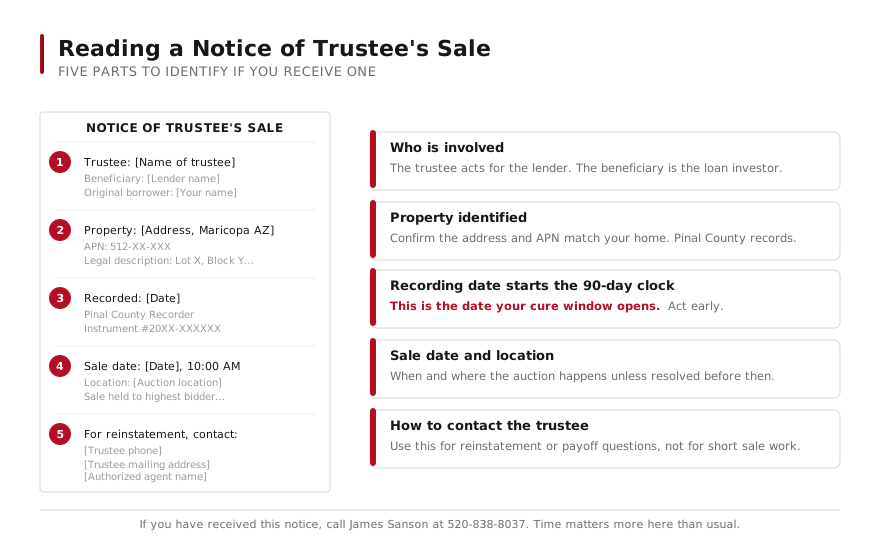
The Notice of Default itself contains specific information you should read carefully. The exact format varies by trustee, but you will typically see:
- The recording stamp shows the date and document number from the Pinal County Recorder. This is what makes it a public record.
- Identification of the deed of trust, including the date you signed it and where it was originally recorded.
- Your name and the name of any co-borrowers.
- The property address and legal description.
- The trustee's name and contact information. The trustee is the third party (often a law firm or specialty trustee company) that conducts the foreclosure on behalf of the lender.
- The beneficiary is the current holder of the loan. This may not be your original lender if your loan was sold or transferred.
- The amount in default is often broken down into past-due principal, interest, fees, and advances.
- A demand for payment or other resolution.
If you have lost the document, you can request a copy from the Pinal County Recorder for a small fee, or you can call the trustee whose contact information appears on the original notice. You should also have a copy that was mailed to you at the property address and any other address the lender has on file.
What it legally means under Arizona law
Under Arizona Revised Statutes § 33-807, the Notice of Default is the formal step that allows the foreclosure process to proceed under the power-of-sale clause in your deed of trust. It is not the foreclosure itself. It is the recorded statement that the loan is in default, and the trustee is authorized to begin the sale process.
From the Notice of Default, the trustee typically proceeds to record a Notice of Trustee Sale under A.R.S. § 33-808. That second notice is the one that actually sets the sale date, and Arizona law requires at least 90 days between the recording of the Notice of Trustee Sale and the actual sale. That 90-day window is your most important remaining timeline. Once it starts, your available options narrow with each passing week.
The recording also creates public notice to anyone who might be interested in the property: junior lienholders, judgment creditors, potential buyers at the trustee sale, and title companies. For a deeper walkthrough of how this fits into the broader Arizona pre-foreclosure schedule, see how long Arizona foreclosure takes.
What happens next, in order
After the Notice of Default is recorded, here is the typical sequence in Arizona:
- The trustee may try to contact you for a brief period (often 30 days, though this varies) to discuss resolution options. This is not a guarantee. Some lenders proceed quickly.
- Notice of Trustee Sale is recorded with the Pinal County Recorder. This document names the actual sale date. It is also posted on the property and mailed to you.
- The 90-day clock begins the day the Notice of Trustee Sale is recorded. Arizona law fixes this minimum.
- The sale date approaches. During this window, you can still pursue reinstatement, a short sale, a loan modification, or a deed in lieu, though each option has shrinking room as the date gets closer.
- The trustee sale occurs on the named date and time at the named location (usually the Pinal County Superior Court steps or another courthouse). Title transfers to the highest bidder, which is most often the lender itself if no third party outbids the opening credit bid.
If you have received a Notice of Default but not yet a Notice of Trustee Sale, you have more flexibility than someone already within the 90-day window. Use this time. Call 520-838-8037 if you want to think through which option fits your situation.
Options you still have right now
Receiving a Notice of Default does not mean you have lost the home. Several paths remain available, and your specific situation determines which ones fit:
Reinstatement
Paying the full past-due amount, plus any late fees, trustee fees, and attorney costs, brings the loan current and stops the foreclosure track. This works only if you can come up with the lump sum, which many homeowners cannot after falling this far behind.
Loan modification
Your lender's loss mitigation department may agree to modify your loan terms (lower interest rate, extended term, or capitalized arrears) to make future payments affordable. This is a separate process from the foreclosure track. Federal rules under the CFPB restrict "dual tracking" in some circumstances, meaning the lender may have to pause foreclosure activity while a complete loan modification application is under review. James does not handle loan modifications directly. A HUD-approved housing counselor or your servicer's loss mitigation department is the right starting point. For a comparison between this path and a short sale, see deciding between loan modification and short sale.
Short sale
If you cannot afford to keep the home and you owe more on it than it is worth, a short sale may be the cleanest exit. Your lender agrees to accept less than the full loan balance from the sale of the home, the buyer pays market value, and the lender's written approval letter states whether any remaining balance is forgiven. A short sale can sometimes pause an active foreclosure if the lender agrees to wait until the sale closes. This is the path James handles directly. See the steps of an Arizona short sale for the full walkthrough.
Deed in lieu of foreclosure
You voluntarily transfer the deed to the lender in exchange for release from the mortgage debt. The lender takes the property without going through a trustee sale. This works in some cases but is not always available, especially if there are junior liens. See how a deed in lieu compares to a short sale.
Bankruptcy
Filing Chapter 7 or Chapter 13 triggers an automatic stay that halts foreclosure proceedings. This is a major legal decision with broad consequences and should only be made after consulting a bankruptcy attorney licensed in Arizona. James does not advise on bankruptcy. If you are considering it, speak with an attorney before making any other decisions about the home.
Doing nothing
If you take no action, the foreclosure proceeds. The Notice of Trustee Sale will be recorded, the sale will occur, and title will transfer to the buyer (typically the lender). Your credit will reflect a completed foreclosure, which is more damaging and longer-lasting than the credit impact of a short sale or deed in lieu. This is not a recommendation. This is what the document predicts will happen if no action is taken.
What you should not do
Some of the worst outcomes in pre-foreclosure do not stem from the original hardship but from decisions made in a panic after receiving a Notice of Default. Avoid these:
- Do not ignore the document. The timeline does not pause because you do not respond. Every day matters.
- Do not sign anything offered by a "foreclosure rescue" company without legal review. Several scam patterns specifically target Arizona homeowners who have just received Notices of Default. See the scams section below.
- Do not transfer the deed to a stranger or unfamiliar entity. Equity-stripping schemes often start this way.
- Do not stop communicating with your servicer. Your loss mitigation department is a legitimate resource. Ignoring their calls and letters removes options.
- Do not file for bankruptcy on the advice of a non-attorney. Bankruptcy is a major legal step. Only a licensed bankruptcy attorney should advise you on whether it is appropriate for your situation.
- Do not assume that a single missed-payment update will fix everything. Once the foreclosure track has started, partial payments may not be accepted or may not stop the process.
If you have already done any of these things, that does not mean you have no options. Call 520-838-8037 or a HUD counselor to talk through where you actually stand. There is usually still a path forward.
Common scams targeting Arizona homeowners
Public foreclosure filings are exactly that, public. Scam operators read these recordings and reach out to homeowners with offers that often sound like a rescue and end with the homeowner losing equity or the home itself. Patterns to watch for:
- "Foreclosure rescue" companies that ask for upfront fees in exchange for "negotiating with your lender." Under the federal MARS Rule, charging upfront fees for mortgage relief services is generally prohibited. If anyone asks you to pay before they have produced a written result, that is a red flag.
- Sale-leaseback schemes, where you sign over the deed in exchange for being allowed to "rent" your own home, with a promise to buy it back later. These often end with the new owner evicting you and keeping the equity.
- Equity-stripping refinances with predatory terms that consolidate your debts but leave you in worse shape, often with a balloon payment you cannot make.
- Fake government affiliations. No legitimate operator will claim to be approved or affiliated with HUD or the federal government in a marketing context. The MARS Rule requires the opposite disclosure.
- Pressure tactics and short deadlines. Anyone telling you to decide today or sign now is selling you something, not helping you.
The Arizona Attorney General and the Consumer Financial Protection Bureau both publish warnings about these schemes. Before signing anything, talk to a free HUD-approved housing counselor or a licensed Arizona attorney.
Talk to a HUD counselor before anyone else
If you do nothing else after reading this page, do this: call a HUD-approved housing counselor. The counselors are non-profit, paid by federal grant funds (so the service is free to you), and they have no incentive to push you toward any particular outcome. They can review your loan documents, your finances, and your options without trying to sell you anything.
You can find one at the HUD housing counselor directory at hud.gov or call the HUD helpline at 1-800-569-4287. There are counselors based in Arizona and counselors who serve Arizona homeowners by phone. Many of them speak Spanish.
If a HUD counselor reviews your situation and determines that a short sale is appropriate, then calling 520-838-8037 makes sense. The James Sanson Team handles the listing, marketing, and lender negotiation side of short sales. We do not advise on loan modifications, bankruptcy, or general legal strategy. For those questions, the HUD counselor or an Arizona-licensed attorney is the right professional.
Important.This page describes the typical mechanics of the Arizona Notice of Default for educational purposes. Your specific situation may have particular legal, tax, or financial dimensions that require professional advice. For legal questions, consult an Arizona-licensed attorney. For free, neutral mortgage assistance counseling, contact HUD-approved housing counselors at hud.gov.
If you have a Notice of Default in hand and want to think through whether a short sale is one of your viable paths, call 520-838-8037. We will be honest about whether it fits, and we will refer you elsewhere if it does not. You can also read about options when facing foreclosure for the broader picture, or read about short sale vs foreclosure if you are weighing those two directly. Our Maricopa AZ short sale team has walked Maricopa homeowners through this exact moment for over two decades.
Tell us about your situation
No pressure, no obligation, no charge. James will call you back personally to discuss your options. For faster help, call 520-838-8037.
Frequently asked questions
How much time does an Arizona Notice of Default give me before foreclosure?
Can I stop the foreclosure once a Notice of Default is recorded?
Is a Notice of Default the same as a Notice of Trustee Sale?
Will the Notice of Default show up on my credit report?
Does an Arizona Notice of Default mean I have to leave the house?
Can I sell my house after I receive a Notice of Default in Arizona?
What if I think the Notice of Default is wrong?
Talk to a Maricopa specialist today
Behind on payments or weighing your options? Call James for a confidential conversation, with no pressure and no obligation.
520-838-8037James Sanson | Real Broker | Licensed in Arizona
Talk to a Maricopa short sale specialist
Call 520-838-8037 now, or fill out the form and we aim to reach out within one business day.