
Options When You Have No Equity in Your Maricopa Home
Six real paths when selling for what you owe is not possible: short sale, deed in lieu, loan modification, refinance, rent it out, or hold and wait.
1,300+ career closings · 267 Zillow reviews averaging 5.0 (October 2026) · Licensed in Arizona since 2002
James Sanson | Real Broker | Licensed in Arizona
If you have no equity in your Maricopa home, your realistic options depend on whether you need to sell, want to sell, or can afford to wait. If you can wait, staying and making payments lets time rebuild equity through principal paydown and likely appreciation. If you need to sell, your options are: bring cash to cover the gap (clean credit outcome; requires cash), rent it out and wait for the equity to return (requires landlord readiness), or pursue a short sale where the lender accepts less than the full balance. Each has different financial and credit consequences. Call 520-838-8037 to discuss your specific numbers.
You have done the math and confirmed you have little or no equity in your Maricopa home. The natural next question is: now what? The honest answer is that you have more options than most homeowners realize, and the right one depends as much on your timeline and circumstances as it does on your specific financial situation. This page walks through every realistic path forward.
The James Sanson Team has worked with Maricopa homeowners in no-equity situations since 2004. We handle short sales directly when that path fits. For other options, we refer you to the right professional. Call 520-838-8037 to discuss which option best fits your situation, with no obligation. If you have not yet calculated your exact equity position, start by calculating your equity to get accurate numbers before deciding anything.
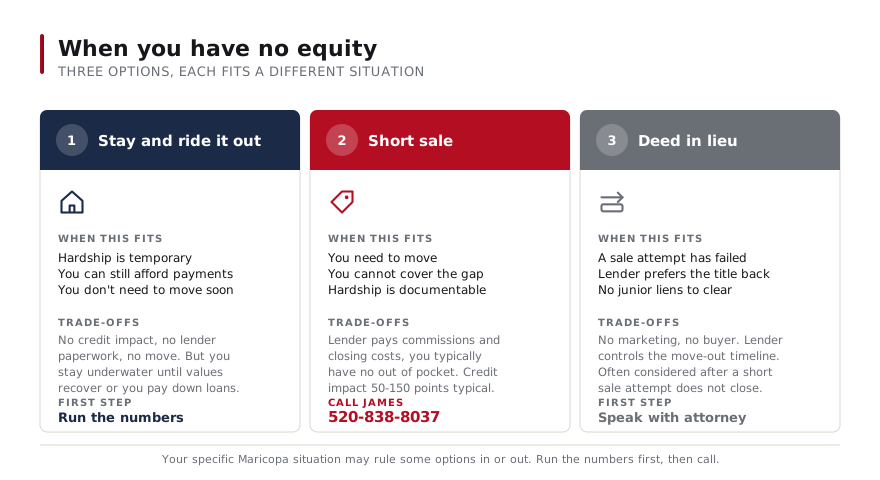
The first question to ask yourself
Before evaluating options, get clear on your situation. The right path depends almost entirely on which of these describes you:
- Can you afford to wait? If you are current on payments and able to keep paying for the next several years, time can resolve the underwater status without you doing anything.
- Do you want to wait? Sometimes, the home, the neighborhood, or the financial logic of staying makes sense even if you could sell. Other times, you have lifestyle reasons to want to move regardless.
- Do you need to move? Job relocation, divorce, family obligation, medical issue, or other life event that requires you to leave the home on a specific timeline.
- Are you struggling with the payments? Income reduction, expense increases, or other financial pressures are making the current payment unsustainable.
Different answers point to different options. A homeowner who is comfortable with their payments and could wait three to five years generally should not pursue a short sale. A homeowner who needs to sell within six months should generally not plan to wait for the market to recover. Match the option to your situation honestly.
Option 1: Wait it out
If you can afford your payments and have no specific reason to sell, the simplest path is to keep paying and let time work. Three things happen over time that close the underwater gap:
- Your loan balance decreases. Each monthly payment includes a principal portion. Early in the loan term, this portion is small (often 20 to 30 percent of the payment), but it grows over the life of the loan. After five years on a 30-year mortgage, principal paydown alone may have reduced your loan balance by 8 to 12 percent, depending on the loan terms.
- Market values typically appreciate over time. Long-term home value trajectory in Maricopa, like most markets, is upward. Year-to-year movement is variable; some years are flat or negative, others gain 5 to 10 percent or more. Over five to ten years, the average is typically positive.
- The combination compounds. A home that is currently $30,000 underwater could easily be at break-even or have modest positive equity within three to five years with normal payments and typical market appreciation. The math depends entirely on your specific loan and the Maricopa market trajectory.
Practical things to do if waiting is your plan:
- Make every payment on time. Missed payments damage credit and remove options that would otherwise be available if your situation changed.
- Do not pull additional equity out of the home through a HELOC or cash-out refinance. Any additional debt deepens the underwater position.
- Maintain the property. Deferred maintenance reduces market value, slowing equity recovery.
- Track values quietly. A free CMA every 12 to 18 months gives you a sense of where you stand without obsession.
Waiting works when you have the financial capacity and no time pressure. It is the lowest-stress option for homeowners who can afford it.
Option 2: Rent the home and wait
If you need to move out of the home (job change, family situation, downsizing) but the home is underwater enough that selling now would result in a financial loss, renting it out is one option. You move out, lease the property to a tenant, and wait for equity to rebuild before selling.
Renting can work when:
- The market rent for your home covers (or comes close to covering) the mortgage payment, property tax, insurance, HOA dues, and a maintenance reserve
- You can comfortably handle months when the property might be vacant or a tenant misses rent
- You have the time, temperament, and bandwidth to be a landlord or hire a property manager (typically 8 to 12 percent of rental income)
- The home is in a neighborhood with reliable rental demand
- Your loan documents allow the property to be rented (most conventional loans do; some loan programs have occupancy requirements that may apply)
Renting does not work as well when:
- Market rents do not cover the carrying costs, leaving you paying out of pocket monthly
- You bought with a loan program (some VA, USDA, or FHA scenarios) where converting to rental affects loan terms or your eligibility for future federal-program loans
- The local HOA restricts rentals (common in some Maricopa communities; check your HOA's CC&Rs)
- You do not have a financial cushion to handle unexpected repairs or vacancies
- Being a landlord remotely (if you are moving out of Arizona) introduces complexity
Renting buys time but introduces ongoing operational responsibility. It is not a passive solution. For some homeowners, it works well; for others, the stress and out-of-pocket cost make it the wrong fit.
Option 3: Bring cash and sell normally
If you need or want to sell and the underwater gap is small enough that you can write a check to cover it, a normal sale becomes possible. The home sells; the buyer pays market value. You bring cash to closing to cover the difference between the proceeds and the loan balance, plus selling costs.
This option works when:
- The gap is small relative to your savings (often under $30,000 to $50,000, though it depends on your finances and other needs for that cash)
- You have the cash available without creating new hardship
- Selling cleanly is a higher priority than preserving the cash
- You want to avoid the credit consequences of a short sale
This is the cleanest option from a credit standpoint. The loan is paid in full. There is no short sale notation on your credit report, no public foreclosure record, and no lender approval process. You sell the home normally and move on.
The trade-off is that you are writing a check (often a substantial one). Whether this makes sense depends on what else you would do with that cash, your tax situation, and how much you value the credit benefits of a clean closure. For some homeowners, paying the gap is the right move. For others, the short sale credit hit is more affordable than the cash outlay. Call 520-838-8037 if you want to think through which side of that line you fall on.
Option 4: Short sale
When the underwater gap is too large to bring to closing in cash, and you cannot or do not want to wait for equity to rebuild, a short sale is typically the path. Your lender agrees to accept the sale proceeds as satisfaction of the loan, even though they will not cover the full balance. The approval letter states whether the lender forgives its loss and whether any deficiency remains for you.
Short sale fits when:
- The underwater gap is meaningful (often $20,000+ after selling costs)
- You have a documented hardship that the lender will accept (job loss, divorce, medical, relocation, business decline, death in the family)
- You cannot or do not want to bring cash to close the gap
- You need to exit the mortgage with the cleanest credit outcome available among the loss-resolution paths
The James Sanson Team handles short sales directly. We have closed short sales for Maricopa homeowners across the 2008 to 2012 downturn and the years since. For the full walkthrough of what the process actually involves, see how a short sale works in Arizona.
If you are considering a short sale but are uncertain whether your situation qualifies, the honest answer often comes from one 30-minute conversation. Call 520-838-8037.
Option 5: Loan modification to stay
If the issue is not really "I need to sell" but "I cannot afford the current payment," loan modification may be the better path. A loan modification permanently changes the terms of your existing mortgage (typically lower interest rate, extended term, or both) so the payment fits your current income. You keep the home, you keep the underwater status for the time being, and your monthly payment becomes manageable.
Loan modification fits when:
- You want to keep the home long-term
- Your hardship has resolved or stabilized (your income now supports a modified payment, even if not the original payment)
- You have a documentable case (income, hardship narrative, financial capacity to make the modified payment reliably)
The James Sanson Team does not negotiate loan modifications. The right starting point is your servicer's loss mitigation department and a HUD-approved housing counselor. The counselor can review your full situation and help you build the application. For more on the comparison between modification and short sale, the Silo 2 page covers it directly.
What not to do
Some patterns repeatedly create worse outcomes than the original problem. Avoid these:
- Do not stop paying without a plan. Strategic default (intentionally stopping mortgage payments without a defined exit strategy) leads to foreclosure with all the credit consequences. If you are considering this, talk to a HUD-approved housing counselor or an Arizona attorney first.
- Do not pay an upfront fee to a "foreclosure rescue" company. The federal MARS Rule generally prohibits charging upfront fees for mortgage assistance relief services. Anyone asking for money before producing a written result is a red flag.
- Do not transfer the deed to a stranger. Equity-stripping schemes often start with "sign your deed to us, and we'll handle the rest." These typically end with the homeowner losing the property and any remaining value.
- Do not refinance into worse terms. Predatory refinance offers (high-cost loans with balloon payments, prepayment penalties, or terms you cannot reliably meet) make the underwater problem worse, not better.
- Do not ignore lender communication. Whether you decide to sell, modify, or stay, communicating with your servicer keeps options open. Silence narrows them.
- Do not panic-sell. If you have time, use it. A poorly-prepared short sale or a forced cash-to-close sale often produces worse outcomes than the same sale planned with a few months of preparation.
Side-by-side comparison
| OptionBest forCredit impactOut-of-pocket cost | |||
| Wait it out | Can afford payments, no urgency to move | None if payments stay current | $0 beyond normal mortgage |
| Rent and wait | Need to move, can afford carrying costs, rentable property | None if payments stay current | Variable; may be cash-flow negative |
| Bring cash and sell | Small gap, have savings, want clean exit | None | Size of the underwater gap plus selling costs |
| Short sale | Significant gap, documented hardship, need to exit | Significant; less than foreclosure | Set by the approval letter |
| Loan modification | Want to keep the home, payment is the problem | Missed payments before the modification cause damage; the modification itself varies in reporting | $0 (HUD counselor assistance is free) |
If your circumstances are forcing a sale (rather than choosing to sell), several Silo pages cover specific scenarios: if you can't keep up with payments, divorce and a short sale, or after a job loss. If you are already behind on payments and worried about foreclosure proceedings, see options when facing foreclosure for the broader pre-foreclosure context.
Important.This page describes, in general terms, options for Maricopa homeowners with no equity. Your specific situation may have legal, tax, or financial dimensions that require professional advice. For legal questions about lien priority, deficiency, or strategic default, consult an Arizona-licensed attorney. For tax questions about debt forgiveness or rental property treatment, consult a CPA. For free, neutral mortgage assistance counseling, contact a HUD-approved housing counselor at hud.gov. Each option above is subject to lender approval, eligibility requirements, and conditions that vary by situation. No specific result can be promised.
The right option depends on facts only you have access to: your income, your timeline, your tolerance for credit damage, and your other financial priorities. We are happy to help you think through which fits, free of charge, with no obligation. Call 520-838-8037 for a confidential conversation. For the broader picture of what "underwater" means and how to assess your situation, return to your options when underwater. Our team has helped Maricopa homeowners through these decisions since 2004.
Tell us about your situation
No pressure, no obligation, no charge. James will call you back personally to discuss your options. For faster help, call 520-838-8037.
Frequently asked questions
Can I sell my home if I have no equity?
How long does it take to rebuild equity in an underwater home?
Is renting an underwater home a good idea?
What if I owe more than the home is worth but can still afford payments?
Do I have to bring cash to close on a short sale?
Can I qualify for a new mortgage right after selling an underwater home?
Should I just walk away from the mortgage if my home is significantly underwater?
Talk to a Maricopa specialist today
Behind on payments or weighing your options? Call James for a confidential conversation, with no pressure and no obligation.
520-838-8037James Sanson | Real Broker | Licensed in Arizona
Talk to a Maricopa short sale specialist
Call 520-838-8037 now, or fill out the form and we aim to reach out within one business day.