
Selling an Underwater Home During an Arizona Divorce: How a Short Sale Works
How Arizona community property rules interact with a short sale, who signs what, and how lender approval works when both spouses are on the loan.
1,300+ career closings · 267 Zillow reviews averaging 5.0 (October 2026) · Licensed in Arizona since 2002
James Sanson | Real Broker | Licensed in Arizona
When divorcing, Maricopa couples with an underwater home often find a short sale is the cleanest exit. The home sells for less than the loan balance, both spouses are released from the mortgage (subject to lender terms), and the divorce can proceed without one party stuck with a house neither wanted. Arizona is a community property state, so both spouses typically must sign on a sale. The short sale needs to be coordinated with your divorce attorney to align with the property settlement. Call 520-838-8037 to discuss whether a short sale is right for your situation. For the legal questions, work with an Arizona-licensed family law attorney.
Divorce is hard enough on its own. When the marital home is underwater, the practical and financial decisions get even more complex. Neither spouse can easily walk away with the home; the other cannot either. Selling for what you owe is not on the table. What is left depends on whether the two of you can cooperate, what your divorce attorneys advise, and what your lender is willing to do.
This page walks through how short sales typically work in a Maricopa divorce situation, what Arizona's community property framework means in practice, and how to coordinate the sale with the legal proceedings. The James Sanson Team has helped Maricopa couples navigate this exact situation many times since 2004. Importantly, the legal questions about your divorce belong with an Arizona-licensed family law attorney, not with us. We handle the sale. Your attorney handles the divorce. Call 520-838-8037 if you want to talk through whether a short sale fits, with no obligation.
Why divorce and underwater homes show up together
The combination of divorce and an underwater home is common enough to be predictable, and several factors drive it:
- Loss of dual income. Many homes are purchased on the assumption that two working adults will contribute to the mortgage. When the marriage ends, neither spouse can typically afford to live in the home alone, even if they wanted to.
- Already strained finances. Many marriages reach divorce after a period of financial strain. The same period that led to the divorce often also led to missed savings, increased credit card debt, or other pressures that affect housing decisions.
- Refinances and HELOCs during the marriage. Couples often refinance or open a HELOC during the marriage to fund renovations, pay debts, or cover unexpected expenses. These transactions reset the equity position and can leave the home underwater years later.
- Market timing. Couples who bought near a market peak and reach divorce a few years later may find the home worth less than their purchase price, especially after accounting for the cost of selling.
- Neither party wants the home. Sometimes, both spouses want a fresh start, and neither wants the responsibility of the home, even if they could technically afford it.
None of this is unusual. It is one of the more common reasons Maricopa homeowners reach out about a short sale.
The Arizona community property factor
Arizona is one of nine community property states. Under Arizona law, most property acquired during the marriage is generally considered community property, regardless of which spouse's name appears on the title or the mortgage. Real estate purchased during the marriage typically falls into this category, with some exceptions for property acquired by gift, inheritance, or with separate funds.
The practical implications for a short sale during divorce:
- Both spouses typically must sign. Even if only one spouse is on the mortgage or on title, the other spouse generally has a community property interest in the home. Selling typically requires both signatures.
- Both spouses are typically affected by the credit impact. If both spouses are on the mortgage, the short sale notation affects both credit reports. If only one spouse is on the mortgage, the credit impact may differ; this is one of many reasons to have an attorney review.
- The divorce decree usually addresses the home. The decree will typically state what will happen to the marital residence, whether it is sold, awarded to one spouse, or handled under another arrangement. A short sale is best coordinated with the decree's terms, not against them.
- Deficiency and tax consequences may be community. Any deficiency the lender does not waive, or any tax consequences from forgiven debt, may be considered community obligations even if only one spouse signed.
None of these is an absolute rule. Arizona community property law has nuance, exceptions, and case-by-case complexity. Anything specific to your situation should be handled by an Arizona-licensed family law attorney. This page describes the typical framework, not legal advice for your specific case.
Why a short sale often fits divorce situations
For couples with an underwater home heading into divorce, a short sale frequently emerges as the cleanest path. Several reasons:
- Both spouses exit the mortgage. Once the short sale closes, neither spouse remains obligated on the loan. The divorce can proceed without one party stuck on a mortgage for a home they no longer have.
- Avoids one spouse taking on the underwater debt. A common alternative is for one spouse to keep the home and the other to be released, but most lenders will not release a co-borrower from a mortgage without refinancing, and an underwater home cannot be refinanced easily. Short sale avoids this trap.
- Resolves the asset cleanly in the property division. The home is no longer a disputed asset and becomes a closed item. Both spouses can plan their post-divorce lives without an open question hanging.
- Provides documented hardship. Divorce-related financial hardship is well-recognized by lenders as a qualifying basis for a short sale.
- Generally avoids the worst outcomes of foreclosure or deed in lieu. The credit impact, future mortgage qualification timeline, and dignity of the process all typically come out better with a short sale than with letting the home go to foreclosure during the divorce.
For more on the specific credit consequences, see what a short sale does to your credit.
The alternatives and why they often fail
Couples sometimes try to avoid a short sale in favor of other arrangements. Some work; some create lasting problems. The most common alternatives and why they often fail:
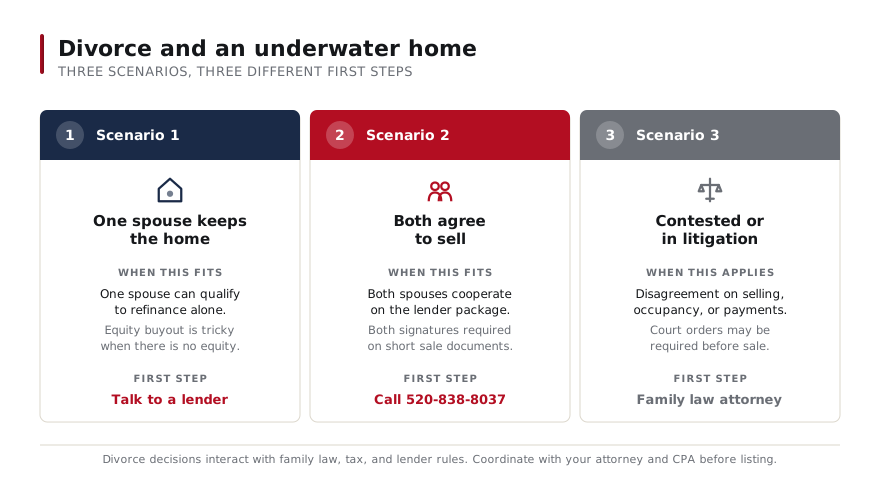
One spouse keeps the home, and the other is released from the mortgage
This sounds reasonable, but it is rarely realistic with an underwater home. Most lenders will not release a co-borrower without a refinance, and an underwater home generally cannot be refinanced. The result: one spouse moves out but stays on the mortgage. If the remaining spouse misses payments years later, the absent spouse's credit takes the hit. Many divorce attorneys specifically counsel against this arrangement for exactly this reason.
Keep paying jointly until the home recovers
Some couples try to maintain joint payments on the home post-divorce until equity returns and a normal sale becomes possible. This works only when both spouses are highly cooperative, financially stable, and able to coordinate for an indefinite period. Most divorces do not produce that level of ongoing cooperation. When one party stops contributing, the other faces a default they did not cause.
One spouse rents the home from the other
Same problems as above, plus additional complications: rental agreements between ex-spouses are often hard to enforce, tax treatment becomes complicated, and the "renting" spouse may stop paying without easy recourse.
Let the home foreclose
The worst outcome. Both spouses get foreclosure on their credit reports; neither has control over timing, and Arizona's foreclosure proceedings continue regardless of the divorce timeline. Most divorce attorneys actively counsel against this option when a short sale is available.
Bankruptcy
Some couples consider joint or individual bankruptcy as part of the divorce. This is a significant legal decision that affects far more than just the home and should only be considered after consulting both a bankruptcy attorney and your divorce attorney. The home does not go away in bankruptcy on its own; the foreclosure or short-sale process is typically still required.
None of these alternatives works as cleanly as a coordinated short sale for most underwater Maricopa couples in divorce. The short sale clears the asset, releases both spouses from the mortgage, and lets the divorce proceed.
Coordinating the short sale with your divorce
A short sale during a divorce works best when the real estate and legal processes are coordinated. The standard sequence:
- Talk to your divorce attorney first. Confirm that a short sale fits the property division strategy in your case. Your attorney can advise on whether the timing should be before, during, or after the divorce decree.
- Have the home valued. A comparative market analysis from a real estate agent provides a realistic value, which serves as the basis for determining whether a short sale is even necessary or whether a normal sale could work.
- Discuss the lender authorization with your attorney. The short sale will require both spouses to sign a listing agreement, an authorization to communicate with the lender, and, eventually, the sale closing documents. Your attorney can help structure these to align with the divorce process.
- List the property. Once both spouses are on the same page about pursuing the short sale, the home is listed at a realistic market price.
- Accept an offer. A buyer's offer is submitted to the lender's loss mitigation department along with hardship documentation, including the divorce status.
- Lender review and approval. The lender evaluates the offer, may order a Broker Price Opinion or appraisal, and either approves, counters, or declines.
- Close. Both spouses sign the closing documents, the sale is completed, and the mortgage is paid off per the terms of the approval letter.
For the full walkthrough of the short sale mechanics independent of divorce, see the steps of a Maricopa short sale.
When both spouses can sign together
The cleanest divorce short sales happen when both spouses agree that selling is the right outcome and are willing to cooperate on the practical steps. This requires:
- Both spouses available to sign the listing agreement
- Both spouses available to make decisions on offers and counter-offers
- Both spouses are able to access the home for showings (or one spouse moved out with the other handling showings)
- Both spouses are willing to provide the hardship documentation the lender requires
- Both spouses are available for the final closing signing (either in person or by mail-out package, depending on the title company)
For couples who can work together at this level, a divorce short sale runs like any other short sale. The fact of the divorce becomes part of the documented hardship, but the mechanics are familiar. Most Maricopa divorce short sales we have closed fall into this category. Call 520-838-8037 to start the conversation.
When one spouse will not cooperate
Sometimes one spouse refuses to sign, refuses to participate, or actively obstructs the sale. This creates real difficulty, and coordination with your divorce attorney becomes especially important.
Common scenarios:
- One spouse wants to keep the home but cannot qualify on their own. The court may order a sale anyway, especially if neither spouse can affordably remain. Your attorney can request specific relief from the court.
- One spouse refuses to engage at all. The divorce court may order participation in the sale, including authorizing one spouse to sign on behalf of the other in some circumstances.
- One spouse demands a price the market will not support. A realistic CMA from a neutral source can provide the data the court needs to set an appropriate listing price.
- One spouse is unreachable or has left Arizona. Service of process, court orders, or special legal procedures may be needed to move forward.
None of these is realistic to handle without a family law attorney. The James Sanson Team is happy to be the real estate professional supporting your situation, but the legal lever-pulling required to move forward when one spouse will not cooperate has to come from a licensed Arizona family law attorney. If you are in this situation, that is your first call.
Timing considerations
When the short sale happens during the divorce process, matters. Several common scenarios:
- Before the divorce is filed. Some couples choose to sell first and divorce after, especially if the sale will simplify the property division. Works when both spouses agree and cooperate.
- During the divorce proceedings. Short sale runs in parallel with the divorce. Most common scenario in our experience. Requires coordination with both attorneys.
- After the divorce decree. The decree orders the home sold and assigns responsibilities for cooperation. Works well when the decree clearly addresses the practical steps.
- Long after the divorce. Sometimes the home was included in the decree, but the spouse who was keeping it later cannot afford it. Short sale at this stage may be more complicated by the original decree language. Worth having your attorney review the decree before listing.
The closer to a forced sale through foreclosure proceedings, the less time the short sale has to complete. If you are approaching pre-foreclosure stages, time becomes the dominant variable. See when you can't afford mortgage payments for the broader urgency framework, and figure out if you're underwater to confirm whether a short sale is even necessary.
Important.This page describes how a short sale typically works during a Maricopa divorce in general terms. Divorce involves legal questions, Arizona community property considerations, tax implications, and credit consequences that vary significantly from case to case. For legal advice on your divorce, consult an Arizona-licensed family law attorney. For tax questions about forgiven debt and divorce, consult a CPA. The James Sanson Team is not a law firm and does not provide legal advice. We provide real estate brokerage services for short sales. Each outcome described above is subject to lender approval, court order, attorney guidance, and circumstances that vary by situation. No specific result can be promised.
For broader options support beyond the legal questions, a free HUD-approved housing counselor at hud.gov can review your full financial picture, independent of the divorce-specific issues, and many counselors have experience working with divorcing couples specifically. They are free, neutral, and federally certified.
If you are heading into a Maricopa divorce with an underwater home and want to talk through whether a short sale fits your situation, call 520-838-8037. We are happy to provide a free comparative market analysis and an honest read on whether a short sale is the right path. The legal questions belong with your divorce attorney; the real estate questions are what we are here for. If you have not yet calculated where you stand financially, start by checking your home equity. For a broader context on what "underwater" means, see "selling when you owe more than the home is worth." To consider other situation-specific paths, see your options without equity or job loss and your mortgage if those fit your situation. The James Sanson Team has guided Maricopa homeowners through divorce-related home sales for over two decades.
Tell us about your situation
No pressure, no obligation, no charge. James will call you back personally to discuss your options. For faster help, call 520-838-8037.
Frequently asked questions
Can I do a short sale during my divorce in Arizona?
What if my spouse will not agree to a short sale?
Does my spouse have to be on the mortgage for a short sale to require both signatures?
Will both of us have a short sale on our credit reports?
Can we get the deficiency split between us in the divorce decree?
What if one of us has already moved out?
Should we wait until after the divorce is final to sell?
Talk to a Maricopa specialist today
Behind on payments or weighing your options? Call James for a confidential conversation, with no pressure and no obligation.
520-838-8037James Sanson | Real Broker | Licensed in Arizona
Talk to a Maricopa short sale specialist
Call 520-838-8037 now, or fill out the form and we aim to reach out within one business day.