1,300+ career closings · 267 Zillow reviews averaging 5.0 (October 2026) · Licensed in Arizona since 2002
James Sanson | Real Broker | Licensed in Arizona
Quick answer
An underwater mortgage means you owe more on your home loan than the home would sell for in today's market. Being underwater is not by itself a problem if you can afford your payments and plan to stay long-term. It becomes a problem when you need or want to sell. In that case, your main options are: bring cash to the table to cover the gap, wait for the market or your loan balance to catch up, or pursue a short sale where your lender accepts less than the full balance. Call 520-838-8037 to talk through your specific numbers, or learn how to figure out if you're underwater first.
By James Sanson, REALTOR®. Licensed in Arizona since August 2002 and focused on the City of Maricopa since 2004. See the team's short sale credentials.
Published May 16, 2026 · Updated September 29, 2026
If you have been hearing about underwater mortgages or you suspect your Maricopa home is worth less than what you owe on it, this page is the right place to start. Being underwater is not unusual, especially for homeowners who bought in a peak market, refinanced near a peak, or pulled equity out over the years. It is also not automatically a crisis.
What matters is what you want to do next. If you can afford your payments and plan to stay in the home for several more years, underwater status often resolves itself with time. If you need to sell, or want to sell, or your monthly payment is becoming unaffordable, the equation changes. This page walks through what underwater actually means, when it becomes a problem worth acting on, and what your realistic options look like in each scenario. The James Sanson Team has helped Maricopa homeowners navigate underwater situations since 2004. Call 520-838-8037 to talk through your specific numbers.
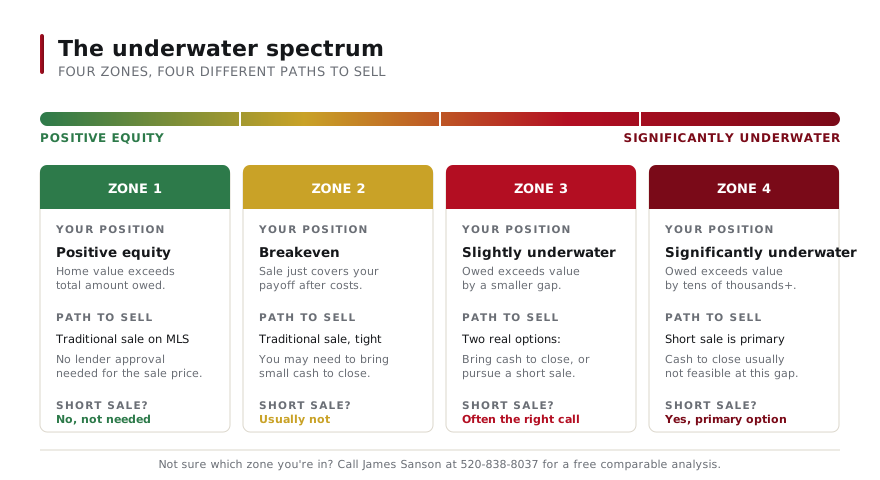
Three zones of underwater mortgage status, and what each typically means for Maricopa homeowners.
What "underwater" actually means
A mortgage is "underwater" (sometimes called "upside down" or in "negative equity") when the unpaid balance on your loan is greater than the home's current market value. The math is simple: if you owe $320,000 and the home would sell for $290,000 today, you are underwater by $30,000.
The current market value is the key variable, and it is also the one homeowners most often misjudge. The number you paid for the home is irrelevant. The Zillow estimate is suggestive but not authoritative. What matters is what a buyer would actually pay for your home in its current condition in the current Maricopa market, based on recent comparable sales nearby. A licensed real estate agent can give you a realistic comparative market analysis (CMA), often at no cost.
The loan balance side of the equation is straightforward: pull your most recent mortgage statement. Add any second mortgages, HELOCs, or home equity loans on the property. That total is what you owe. Subtract that from the market value, and you have your equity (or, if negative, the size of the underwater gap).
How homeowners end up underwater in Maricopa
Several common paths lead to an underwater mortgage in Maricopa specifically:
Bought at or near a market peak. Maricopa's real estate market has historically had cycles. Homeowners who bought during peak periods sometimes find their homes worth less than they paid for years afterward, especially if they put little down.
Low down payment loans. FHA loans (3.5% down), VA loans (0% down for eligible veterans), USDA loans (0% down), and conventional loans with 3% or 5% down all start the homeowner with minimal equity. Any market dip or major repair cost can flip the equation.
Refinanced and pulled cash out. Cash-out refinances reset your loan balance to a higher amount. If you refinanced near a market peak and pulled equity out, you may now owe substantially more than the home is worth.
Second mortgages or HELOCs. A first mortgage that is well covered by the home's value can still leave you underwater overall if a second mortgage or HELOC pushes the total over the value line.
Local market shifts. Even within Maricopa, neighborhood-level dynamics matter. Some communities (Rancho El Dorado, Province, Glennwilde, Cobblestone Farms) have different value trajectories than others.
Property condition issues. Major needed repairs (roof, HVAC, foundation, pool, structural) can reduce the realistic sale price below what the loan balance reflects.
None of these are unusual. Many Maricopa homeowners have been or currently are underwater on their homes, and most do not realize it because they are not actively trying to sell.
When being underwater actually matters
This is the part many anxious homeowners need to hear: being underwater is not, by itself, a crisis. If you can afford your monthly payments and plan to stay in the home for the next several years, the underwater status often resolves itself over time. Your loan balance decreases with each payment, and market values typically appreciate over time. The gap closes.
Underwater becomes a problem in specific situations:
You need to sell. Job relocation, divorce, family obligations, health issues, or any other circumstance that necessitates a move.
You want to sell. Lifestyle change, retirement, downsizing, or upgrading. A normal sale will not work if the proceeds do not cover what you owe.
You cannot afford the payments. Income change, expense increase, divorce-related budget shock, or other financial pressure. Underwater status compounds the problem because you cannot easily sell your way out.
You want to refinance. Refinancing typically requires equity, and underwater homes generally do not qualify for traditional refinance products.
You are considering walking away. "Strategic default" is a real consideration for some homeowners, though it carries significant credit and legal consequences and should be considered only after consulting a HUD-approved housing counselor or an Arizona attorney.
If none of these apply to you right now, and you can comfortably keep paying your mortgage, the underwater status is more of a data point than a problem. Keep an eye on it, but you do not need to take any action.
Figuring out where you stand
Before deciding whether to do anything, get accurate numbers. Many homeowners discover they are not as far underwater as they feared, or in some cases, that they have small positive equity once accurate figures are used. The basic calculation:
Get the current market value. Request a comparative market analysis (CMA) from a local real estate agent. We are happy to provide one at no cost for Maricopa homeowners. Online estimates from Zillow, Redfin, or Realtor.com are starting points but often miss neighborhood-specific factors.
Get the current loan balance. Pull your most recent mortgage statement. The figure to use is the principal balance, not the original loan amount.
Add any second mortgages or HELOCs. Even if you have not touched a HELOC in years, the line counts as long as it is open with a balance.
Add any liens. Tax liens, judgment liens, HOA arrears liens, or mechanic's liens on the property all reduce your effective equity.
Subtract. Market value minus total liens equals your current equity position. If negative, that is the size of the underwater gap.
For a deeper walkthrough, including the specific math and how to read the numbers, see how to calculate if you're underwater. If you want a free CMA for your home in Maricopa with no obligation, call 520-838-8037.
Option 1: Stay and keep paying
If you can afford your payments and have no specific reason to sell, staying put is often the right answer. Time does the work for you:
Your loan balance decreases. Each payment includes a principal portion that builds equity. Early in a loan term, this portion is small, but it grows each month.
Market values typically appreciate over time. Real estate is cyclical, but the long-term trajectory in Maricopa has been upward.
The longer you stay, the more cushion you build. Five years of payments plus typical appreciation often resolves the underwater gap entirely, especially in homes that started only modestly underwater.
If staying is your plan, there are a few practical things worth doing:
Make every payment on time. Late payments damage your credit and eliminate some options that would otherwise be available if your situation changes.
Avoid pulling additional equity out of the home through a HELOC or cash-out refinance. Any additional debt against the property deepens the underwater position.
Maintain the property. Deferred maintenance reduces market value, which keeps you underwater longer.
Watch the market quietly. You do not need to obsess, but knowing roughly where values are trending in your neighborhood gives you data if your situation changes.
Option 2: Bring cash to close the gap
If you need to sell and you can bring cash to the closing table to cover the difference between sale proceeds and what you owe, a normal sale becomes possible. The home sells, the buyer pays market value, you write a check for the remaining balance, and the mortgage is paid off in full.
This option works when:
The underwater gap is small relative to your savings (often under $30,000 to $50,000, though it depends on your finances)
You have the cash available without creating financial hardship
Selling the home is a higher priority than holding the cash
You want to avoid the credit consequences of a short sale
This is the cleanest option from a credit standpoint because the loan is paid in full. There is no short sale notation on your credit report, no public foreclosure record, and no negotiation with the lender. You simply sell the home and pay off the mortgage like any normal transaction.
It is also the most financially expensive option in absolute dollars. You are writing a check for the gap. Whether this makes sense depends on your specific finances, your plans for the cash you would use, and your tolerance for the credit alternatives. Call 520-838-8037 if you want to think through whether this fits your situation.
Option 3: Short sale
If selling is necessary and bringing cash is not realistic, a short sale is typically the path. In a short sale, your lender agrees to accept the sale proceeds as satisfaction of the loan, even though they will not cover the full balance. You sell the home to a buyer, and the lender's written approval letter states whether any remaining balance is forgiven.
Short sale fits when:
You owe meaningfully more than the home is worth (often $20,000+ underwater)
You have a documented hardship that the lender will accept (job loss, divorce, medical, relocation, business decline, death in the family)
You cannot or do not want to bring cash to close the gap
You want to exit the mortgage with the cleanest credit outcome available among the loss-resolution options
The James Sanson Team handles short sales directly. We have walked Maricopa homeowners through this since 2004 and have closed short sales between the 2008-2012 downturn and recent years. For the detailed walkthrough of what the process actually involves, see the Maricopa short sale process. For the specific credit consequences, see how a short sale affects your credit. If you are exploring whether a short sale fits your situation, call 520-838-8037 for a no-pressure conversation.
When life forces a decision
For many homeowners, the question of what to do about being underwater is not theoretical. A specific life event has made selling necessary or made the current payments unsustainable. Several common situations show up repeatedly in Maricopa:
Divorce. Marital separation often forces a decision about the home. Underwater status complicates the division of assets and the practical question of what to do with a property neither spouse can keep alone. See short sale during divorce for a deeper walkthrough.
Job loss or income reduction. A sudden change in household income can quickly turn an affordable mortgage into an unaffordable one. See job loss and your mortgage for the typical paths forward.
Mortgage payment becoming unaffordable. Beyond job loss, payment shock can come from an adjustable-rate mortgage resetting, a HELOC moving from interest-only to principal-and-interest, property tax increases, or insurance hikes. See when you can't afford mortgage payments for the realistic options.
Medical or family emergency. Health crises, family obligations requiring relocation, or other unexpected life changes can force a move that the underwater home is not ready for.
Relocation for work or other reasons. A required move with insufficient equity to cover a normal sale necessitates choosing among the options above.
If you are in one of these situations, your underwater status is now an operational problem rather than a data point. The earlier you start exploring options, the more flexibility you have. If you are not yet behind on payments, you have more time to weigh choices than if you are already in pre-foreclosure. For a broader context on the foreclosure-related side, see pre-foreclosure help in Maricopa. For situations specifically without equity, see options when you have no equity.
Important.This page describes underwater mortgage scenarios for Maricopa homeowners in general terms. Your specific situation may have legal, tax, or financial dimensions that require professional advice. For legal questions, consult an Arizona-licensed attorney. For tax questions about debt forgiveness or cash-to-close scenarios, consult a CPA. For free, neutral mortgage assistance counseling, contact a HUD-approved housing counselor at hud.gov. Each option above is subject to lender approval, eligibility requirements, and circumstances that vary by situation. No specific result can be promised.
If you suspect you are underwater and want accurate numbers before making any decisions, call 520-838-8037 for a free comparative market analysis of your Maricopa home. We will give you an honest read on your equity position and walk you through which options realistically apply to your situation. There is no cost to talk and no pressure to do anything afterward. The James Sanson Team has helped Maricopa homeowners through underwater scenarios for over two decades.
Tell us about your situation
No pressure, no obligation, no charge. James will call you back personally to discuss your options. For faster help, call 520-838-8037.
1,300+
Career Closings
267
Zillow Reviews, October 2026
22+
Years in Maricopa
5.0
Average Rating
Licensed since August 2002Maricopa focus since 2004Short sale experience since 2008
Meet the team
James personally handles every short sale listing he takes. David Hoos and David Ruiz are buyer specialists who help when our short sale listings need buyers, and David Ruiz also takes listings for sellers who prefer Spanish.
James Sanson
Listing Specialist, Lead Short Sale Negotiator
Licensed Arizona real estate agent since August 2002, focused on Maricopa since 2004. 1,300+ career closings. Built the short sale practice during the 2008-2012 downturn. Personally manages every short sale listing he takes.
David Hoos
Buyer Specialist
7 years in Maricopa. Works with buyers, including those writing offers on our short sale listings. Patient, thorough, answers the phone.
David Ruiz
Bilingual Buyer Specialist
Habla español. 8 years experience. Works with buyers across 85138 and 85139, including those writing offers on our short sale listings.
Frequently asked questions
Is being underwater on my mortgage the same as being in foreclosure?
No. Underwater simply means you owe more on the mortgage than the home would currently sell for. It says nothing about whether you are making payments on time. Many homeowners are underwater but completely current on their payments and not facing foreclosure. Foreclosure is a separate process that begins only after missed payments. Being underwater becomes a problem only when you need to sell or cannot afford payments.
How can I find out if I'm underwater without a real estate agent?
You can get a rough estimate using online valuation tools (Zillow Zestimate, Redfin Estimate, Realtor.com) and compare it against your most recent mortgage statement and any second mortgages or HELOCs. The online estimates are often off by 5 to 15 percent in either direction, so use them only as a starting point. For a realistic number, a local real estate agent's comparative market analysis is more accurate and usually free.
Can I refinance an underwater mortgage in Arizona?
Traditional refinance products generally require equity, so most underwater homeowners do not qualify. There have been federal programs in the past (such as HARP, which ended in 2018) designed for underwater refinancing, but availability comes and goes. Talk to a licensed Arizona mortgage loan officer about what current options exist. If you are also facing payment hardship, a loan modification through your existing lender may be a more realistic path than refinancing.
What happens if I just walk away from an underwater mortgage?
Walking away (sometimes called strategic default) leads to foreclosure. Arizona's anti-deficiency statutes (A.R.S. § 33-814 and § 33-729) limit the lender's ability to pursue you for the unpaid balance after foreclosure of certain residential properties, but these protections are nuanced and do not apply universally. The credit consequences are significant and last for years. This is a major decision that should be made only after consulting a HUD-approved housing counselor or a licensed Arizona attorney.
Is it true that home values always come back?
Real estate values have historically followed a long-term upward trend, but the timing and magnitude vary dramatically by market and period. Maricopa values, like most markets, are cyclical. Homeowners who bought in 2006 in Maricopa waited many years for values to recover to their purchase prices. The lesson is that values typically recover, but the time horizon can be longer than you would expect, and that may not align with your need to sell or refinance.
Can I do a short sale if I'm still current on my mortgage?
Yes, in many cases. Being current on your payments does not automatically disqualify you from a short sale. What matters more is whether you have a documented hardship and whether the home is genuinely worth less than you owe. Some lenders are more flexible than others about pre-default short sales. If you anticipate a hardship (planned divorce, expected job change, scheduled relocation), starting the conversation early often produces better outcomes than waiting until you have missed payments.
How much does it cost to get a CMA on my Maricopa home?
We provide comparative market analyses at no charge for Maricopa homeowners exploring their options. There is no obligation. We pull recent comparable sales, current listings, and pending sales in your neighborhood, factor in your home's condition and features, and provide a realistic value range. The whole conversation typically takes about 30 minutes.
Talk to a Maricopa specialist today
Behind on payments or weighing your options? Call James for a confidential conversation, with no pressure and no obligation.